Skip to content

404 · Page not found

That page isn’t available.

This address doesn’t match a published Go Digital Income page.

Return to the Go Digital Income homepage
GO DIGITAL INCOME
How it works Beginner roadmap Order ↗

A clear starting point for beginners

Build Your Online Income System - Even If You Have Zero Experience.

A practical introduction to thinking in systems: choose a useful offer, give people a clear place to find it, share helpful information, and learn from the signals you receive. Start with fundamentals, not a promise of instant results.

See Go Digital Income Details → Explore the approach

The order link opens the product destination in a new tab. Review its details before deciding what to do next.

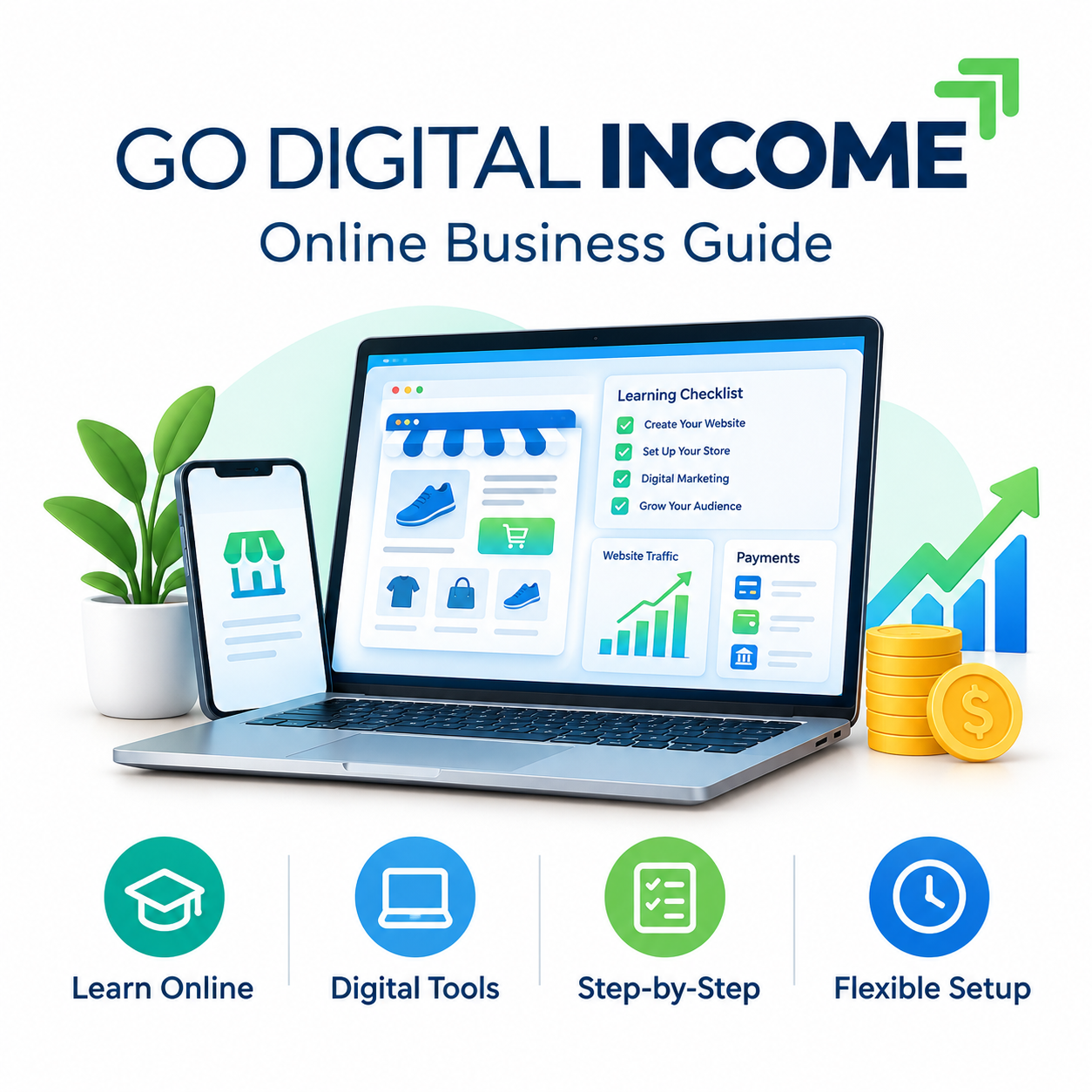
Go Digital Income online business guide artwork showing a laptop with a digital storefront and learning checklist, alongside the phrases Learn Online, Digital Tools, Step-by-Step, and Flexible Setup.
Product reference image supplied for this page.
01Learn online at your pace
02Use practical digital tools
03Follow a step-by-step path
04Adapt the setup to your goals

The idea behind the system

Online income is not one magic tactic. It is a set of connected pieces.

Thinking in systems helps make a complicated subject feel more understandable. Instead of collecting random tactics, map how a person discovers something useful, understands its value, and chooses whether to take a next step.

A digital income system is a repeatable way of connecting a useful offer with people who may value it. The word system matters: an offer on its own may be hard to discover; content without a clear purpose can be difficult to improve; and a website without an audience may sit unseen. Each part has a job, and each part should make the next part easier to understand.

For a beginner, a simple map might include a defined audience, one specific problem, an offer that addresses that problem, a place where people can learn more, and a method for reaching relevant people. The map does not need to be elaborate. In fact, fewer moving parts often make it easier to spot what is unclear. A single useful page and a consistent learning routine can teach more than building several unfinished channels at once.

This approach is about process, not certainty. People make choices for many reasons, and online activity can change with audience needs, competition, platform rules, and the quality of the work. Planning can create structure; it cannot guarantee that a visitor will buy or that a particular result will follow. Treat each step as an opportunity to learn and make the next version more useful.

The graphic above illustrates common building blocks such as a storefront, learning checklist, traffic, and digital payments. Think of it as a visual starting point rather than proof of a particular outcome. A reliable foundation is built through useful work, clear communication, consistent practice, and responsible evaluation.
A beginner-friendly framework

Four connected parts make the work easier to organize.

You do not have to master every platform or tool before taking a first learning step. Begin with the purpose of each part, then choose simple actions that fit your time, abilities, and audience.

1

Choose a real audience and a useful problem

Start by describing who you hope to help and what they are trying to do. “Everyone” is too broad to guide useful communication. A focused audience gives you a better chance of understanding the questions people actually ask. Listen before you build: read public discussions, note repeated obstacles, and use respectful conversations to check your assumptions. You are looking for a problem that is understandable and appropriate for you to address, not a dramatic story that exaggerates people’s worries.

2

Define an offer and explain it plainly

An offer is the next useful thing a person can consider: a service, a product, a resource, or another legitimate solution. Explain what it is, who it is for, what it helps someone do, and what it does not promise. Use ordinary words. Avoid vague claims that a system “does everything” or guarantees a specific outcome. When the offer belongs to someone else, be transparent about your relationship and describe it accurately. Trust is built through clarity, not pressure.

3

Create a useful home online

A home online can be a focused page, a portfolio, a shop, or another suitable destination where a visitor can understand what you are sharing. Make the central action easy to recognize. Organize the information so a person can decide whether to continue without feeling confused. Include accurate descriptions, working links, and relevant contact or policy information for your context. Before promoting the page, open it on a phone and check that it loads, reads well, and makes the next step obvious.

4

Reach people, observe, and improve

People need a reasonable way to discover your work. That might involve helpful search-focused articles, short educational posts, a newsletter, community participation, partnerships, or another channel suited to your audience. Choose a channel you can maintain and follow its rules. Look at relevant signals—such as whether people see, read, or respond to the information—and make one thoughtful adjustment at a time. Do not mistake activity for progress; useful feedback and honest communication matter more than a busy-looking dashboard.

Choose a model with care

There is more than one way to build online value.

Different models ask for different skills and responsibilities. These examples are general education, not a claim that every model is included in the product or suitable for every person. Compare the real work involved before committing to a direction.

Model 01

Offer a service

A service business exchanges a defined skill for a clear deliverable. Examples include editing, tutoring, design, consulting, or technical support when you have the competence to provide it. A thoughtful first step is to describe one small, specific outcome, identify the kind of client who needs it, and show evidence of your capability without overstating experience. Services can be a direct way to learn what customers value, but they require communication, delivery, boundaries, and dependable follow-through. Consider your capacity before taking on commitments.

Model 02

Create a digital resource

A digital resource—such as a workbook, lesson, template, or reference—can package knowledge into a format people can use. Begin with a narrow question you understand well and validate that the proposed resource is genuinely helpful. Clear instructions, accessibility, accurate information, and updates are part of the work. A download does not become useful merely because it is digital, and creating a resource does not ensure an audience will find it. Plan how people will discover it and how you will respond to feedback.

Model 03

Recommend a relevant product

Some publishers introduce products made by other businesses and may receive compensation when a reader takes an action. If you explore this route, learn the program’s conditions, disclose material relationships clearly, and recommend only what you can describe responsibly. Your role is not to disguise promotion as neutral advice. Explain what you know, distinguish firsthand experience from general information, and make room for a reader to decide that a product is not right for them. Reputation and compliance should come before a short-term click.

Model 04

Build a focused shop or catalog

An online shop presents products to people who may want them. Useful product descriptions, accessible navigation, accurate delivery details, customer service, and clear policies all matter. A catalog is a business operation, not just a collection of attractive pages. Before selecting a platform or expanding a range, understand the responsibilities connected to fulfilment, customer questions, returns, taxes, and consumer protection in the places where you operate. Start with a scope you can manage and verify every important detail.

Choose the work, not only the headline. A model is more promising for you when it fits your skills, schedule, appetite for customer interaction, and willingness to keep learning. No model removes uncertainty or makes due diligence optional.

A simple learning sequence

Move forward in small, reviewable steps.

This sample four-week sequence is a study structure, not a timetable for earnings. Use more time whenever a task needs it, and keep notes on what you learn instead of rushing to publish unfinished work.

First: understand the audience

Write a short description of a group you can serve and the task they want to complete. Find recurring questions from legitimate, public sources. Note the words people use, what they already try, and where guidance seems incomplete. Record which ideas are observations and which remain assumptions. Do not collect personal data without a lawful, respectful reason, and do not treat a few comments as evidence of universal demand. End this stage with one clear problem statement and a list of what you still need to learn.

Next: shape a helpful offer

Compare possible solutions and choose an offer that you can explain honestly. If it is your service or resource, define the scope and what a customer can reasonably expect. If you are sharing a third-party product, verify its details and any program conditions directly. Draft a plain-language description and ask a trusted reader whether it is understandable. Remove statements you cannot substantiate. A modest, specific promise about the work itself is more trustworthy than a sweeping promise about someone’s future.

Then: make a clear destination

Create one useful page or profile that introduces the audience, the problem, and the next step. Organize it around the questions a visitor needs answered. Review spelling, accessibility, and mobile layouts; use descriptive headings and link labels; test each call to action. Include relevant disclosures and policies for your model and region. Ask someone unfamiliar with your idea to explain what they think the page offers. Their confusion can show you which section needs simpler language.

Finally: share and learn

Select one appropriate discovery channel and make helpful contributions consistently, while following that platform’s rules. Share information that has standalone value rather than posting only promotional messages. Observe which questions remain unanswered and whether your destination helps people take the action you intended. Change one element at a time so you can learn from the result. Keep realistic records, pause when something feels misleading, and let evidence guide the next experiment rather than escalating effort automatically.

Progress is not a countdown. Some steps take longer because research, skill practice, or compliance questions deserve care. A learning plan is useful only when it supports good decisions, not when it pressures you to publish before you are ready.

What to measure

Look for learning signals, not just numbers.

Measurement is most helpful when you connect a signal to a question. A number by itself is not a verdict on your ability or a reliable forecast of what happens next.

Start by deciding what you want to learn. If the question is whether a headline is clear, ask a few relevant readers what they believe the page is about. If the question is whether people can find a resource, examine appropriate, aggregated page activity. If the question is whether a service description fits the problem, hold respectful conversations and note the questions that recur. Choose measurements that are proportionate to the decision and avoid tracking personal information you do not need.

Clarity

Can a new visitor explain who the page is for and what action it invites?

Relevance

Do the topics and examples address questions your intended audience recognizes?

Usability

Can people read, navigate, and use the page across devices and assistive settings?

Keep a simple decision log: what you changed, why you changed it, and what you observed afterward. Avoid drawing strong conclusions from a tiny sample, a short time window, or one unusual response. An increase in visits may not mean the offer is right; a quiet response may mean the page, audience, timing, or channel needs more investigation. Consider several explanations before you decide.

Use metrics as prompts for questions, not as substitutes for judgement. If a tactic depends on misleading urgency, hidden affiliations, fabricated testimonials, or careless use of someone’s information, a favorable metric does not make the tactic responsible. Long-term credibility depends on the quality and honesty of the experience people actually receive.

Common beginner traps

Protect your attention and the trust you are trying to earn.

Many early challenges come from trying to do too much, choosing actions without a clear question, or believing confident claims that leave out important context. A deliberate pace makes it easier to notice those traps.

✓Do not build five channels at once. Start where the people you hope to help already look for information, then learn that channel’s expectations.
✓Do not confuse polish with usefulness. Design matters, but clear information, a real audience need, and a working destination matter too.
✓Do not copy claims you cannot verify. Check product details and support statements with primary sources; omit claims that cannot be substantiated.
✓Do not treat attention as consent. Communicate respectfully, follow privacy requirements, and provide only the messages people have agreed to receive.
✓Do not hide commercial relationships. Make relevant affiliations and incentives easy to notice before a person acts.
✓Do not let a deadline replace judgement. Take time to understand the offer, terms, and responsibilities before making a decision.

A useful rule is to pause whenever a message suggests that success is automatic, that no work is involved, or that a result is typical without clear evidence. Ask what activity is required, what assumptions are being made, what risks exist, and what happens if the outcome is different from the example. If those questions are difficult to answer, seek independent information and do not rely on a promotional page as your only source.

Set expectations before you begin

Learning a system is useful. Results still depend on many factors.

Online business outcomes vary. Your results, if any, will depend on your context, choices, experience, time, audience, offer, execution, and conditions that may be outside your control.

A guide or educational resource can help organize ideas, but it cannot do the work on your behalf. You may need to practise unfamiliar skills, revise your explanation, learn how to use tools, or discover that an initial idea is not a good fit. There may be periods when you see little response. Those experiences are not proof that you should spend more, publish faster, or keep pursuing the same direction. They are a reason to evaluate what you know and what remains uncertain.

Do not make a personal, professional, or financial decision on the assumption that a particular income will arrive. Consider your own obligations and seek qualified guidance for legal, tax, or financial questions relevant to your location and situation. The information on this page is general educational content, not a personalized recommendation. Check the terms and disclosures on the destination page before ordering or sharing information.

Healthy expectations allow you to keep experimenting without turning uncertainty into self-blame. Focus on work you can control: learning, communicating clearly, making the experience more useful, and treating other people fairly. Those are worthwhile measures of progress even before you can evaluate business results.

Is this approach for you?

Look for alignment, not a shortcut.

Use the questions below to decide whether a beginner-focused introduction is relevant to what you want to learn next.

+It may fit what you are exploring if…

  • You want to understand the basic components of a small online business or digital offer.
  • You are comfortable learning gradually and testing ideas instead of expecting a guaranteed result.
  • You want a framework for asking better questions about audience, offer, website, and outreach.
  • You are willing to verify details and decide whether the destination offer suits your circumstances.
  • You can set reasonable boundaries around your time and the commitments you choose to make.

?Pause and seek more information if…

  • You need a certain or immediate income result and are relying on one product to provide it.
  • You are being pressured to decide before you understand the terms, details, or obligations.
  • You expect to earn without learning skills, serving an audience, or doing ongoing work.
  • The claims you have seen are not supported with transparent context or credible evidence.
  • The next step would conflict with your own financial limits, values, or responsibilities.

Straight answers

Questions beginners often ask.

Do I need previous online business experience?

The headline is aimed at people who are new to the subject. Starting without experience does not mean there is nothing to learn. You may need to develop basic skills in communication, customer understanding, content, or digital tools. Work through unfamiliar ideas at a pace that helps you understand them, and verify that any product or training you consider actually matches your learning needs.

Does following a system guarantee an income?

No. No system can guarantee that you will earn money. Outcomes vary and depend on many factors, including the offer, audience, effort, execution, timing, and conditions outside your control. This page does not promise a result. Treat educational material as a way to learn and organize decisions, not as assurance of a particular outcome.

What should I understand before using the order link?

Review the product destination independently before deciding. Confirm what is included, who provides it, any applicable terms, cancellation or support information, data practices, and any statements about expected results. If important details are unclear, ask the provider or wait until you have enough information. The button is simply a link to the destination, not a substitute for reviewing its terms.

Which online business model should I start with?

There is no single best model for everyone. Consider the skills you have or are willing to learn, the problem you want to address, the kind of ongoing work involved, and the responsibilities attached to each option. Compare models using current, independent information. A narrow first experiment can help you learn without assuming that you must immediately build a large operation.

How much time should I expect to spend?

That depends on the model, your available time, your existing skills, and the amount of research and practice your idea needs. Be wary of claims that reduce all work to a fixed, universally minimal routine. Make a realistic schedule, include time to maintain what you create, and revisit that schedule if the work starts to conflict with other responsibilities.

Can I change direction if my first idea is not working?

Yes. A learning process should leave room to update your assumptions. First identify what you expected to learn and what the available feedback actually says. You might revise the audience, offer, page, or channel, or pause to build a missing skill. Make thoughtful changes based on evidence rather than copying a tactic simply because someone else reports a different experience.

Take the next informed step

Start with a clearer map. Decide only after you understand the details.

Explore the Go Digital Income destination if you want to review the product information. Read the terms carefully, consider whether the material fits your goals, and make a decision that reflects your own circumstances. Learning is a process; no particular income outcome is promised.

Visit the Go Digital Income order page →

Important information: This page is for general educational and promotional purposes. It does not provide business, legal, tax, or financial advice. No earnings or business results are guaranteed, and no typical-results claim is made. Outcomes vary based on individual circumstances, decisions, effort, experience, audience, offer, and external conditions. Review the product provider’s current information, disclosures, and terms directly before making a decision. If this page links to a commercial offer, evaluate it independently and seek qualified advice when appropriate.

© 2026 Go Digital Income. Informational page.Order destination